

By Dr Oleg Konovalov
Governments measure growth, budgets, productivity, programme delivery and citizen satisfaction. But do they measure whether their leadership system has enough capacity to deliver future ambition?
Governments are among the most measured institutions in the world.
Economic growth, budgets, productivity, programme delivery, human capital, digital transformation and citizen satisfaction are all measured extensively.
This measurement matters. Governments need to know whether policies are working, investments are producing results and institutions are delivering against their mandates.
Yet one critical question rarely receives the same systematic attention:
Does the leadership system have sufficient capacity to deliver the level of ambition government expects of it?
This question becomes increasingly important as national ambition accelerates.
Transformation programmes are expanding. Artificial intelligence is reshaping work and decision-making. Public expectations are increasing. Institutions are expected to become faster, more efficient, more innovative and more responsive, often simultaneously.
Behind every one of these expectations are leaders who must convert ambition into decisions, decisions into coordinated execution, and execution into sustainable outcomes.
Yet there is a dangerous assumption embedded in many transformation efforts: that Leadership Capacity will automatically expand as ambition expands.
It does not.
When Leadership Demand Exceeds Leadership Capacity
More leaders do not necessarily mean more Leadership Capacity. Nor do larger budgets, more technology or additional organisational structures automatically make a leadership system more capable.
Meanwhile, every new strategic priority, transformation programme, technological shift, stakeholder expectation and organisational dependency creates additional Leadership Demand.
Leadership Demand is the total leadership requirement generated by an institution's ambitions, responsibilities, complexity and pace of change.
The critical issue is what happens when Leadership Demand begins to exceed available Leadership Capacity.
The first signs may not appear in conventional performance indicators. Leaders often experience them much earlier:
- More decisions reach senior levels.
- Issues that should be resolved lower in the organisation are escalated.
- Calendars become saturated.
- Coordination consumes increasing amounts of executive attention.
- Time for thinking disappears.
- Firefighting begins replacing foresight.
The institution may still appear to be performing successfully. Targets may be achieved and programmes delivered.
But beneath those results, something important may be changing.
A government institution can continue meeting today's targets while progressively consuming tomorrow's Leadership Capacity to sustain today's performance.
That is precisely what makes the problem dangerous.
Performance indicators tell government what has happened. Leadership Capacity helps determine whether the system is capable of delivering what must happen next.
The Missing Dimension of Performance
Performance and capacity are not the same thing.
Consider two institutions producing similar results.
One may be operating close to the limits of its Leadership Capacity, with little reserve for additional complexity, disruption or responsibility. The other may achieve comparable results while retaining substantial Leadership Capacity for emerging priorities and future demands.
Conventional performance measures may make those institutions appear equally healthy.
They are not.
This distinction becomes particularly important for governments pursuing ambitious transformation agendas. The question is no longer simply whether an institution is performing today. It is whether its leadership system possesses sufficient capacity to sustain performance while delivering what comes next.
That requires asking different questions:
- Where is Leadership Capacity being lost between strategic intent and execution?
- Where are decision bottlenecks forming?
- How dependent is execution on a small number of senior leaders?
- Where is responsibility greater than the capacity or authority to exercise it?
- How effectively does strategic clarity survive through successive leadership levels?
- Where is leadership attention being consumed without creating corresponding value?
- How close is the leadership system to the point where additional Leadership Demand begins to impair its ability to deliver?
Measuring Leadership Capacity
This challenge led me to develop the National Leadership Capacity Index (NLCI) at the Visionary Leadership Institute.
NLCI represents a progression in how we think about leadership.
If Leadership Capacity is an institutional capability rather than simply the accumulated competence of individual leaders, then governments need a way to determine how much capacity exists across the leadership system, and whether it is sufficient for the Leadership Demand being placed upon it.
NLCI establishes an evidence-based baseline of institutional Leadership Capacity. It identifies where capacity is constrained or being lost, where leadership bottlenecks may be affecting execution, where strategic investment may be exposed, and what needs to be strengthened first.
The principle is straightforward:
Measure → Understand → Strengthen → Re-measure
To translate this principle into a practical process, I developed the DIAMOND Framework:
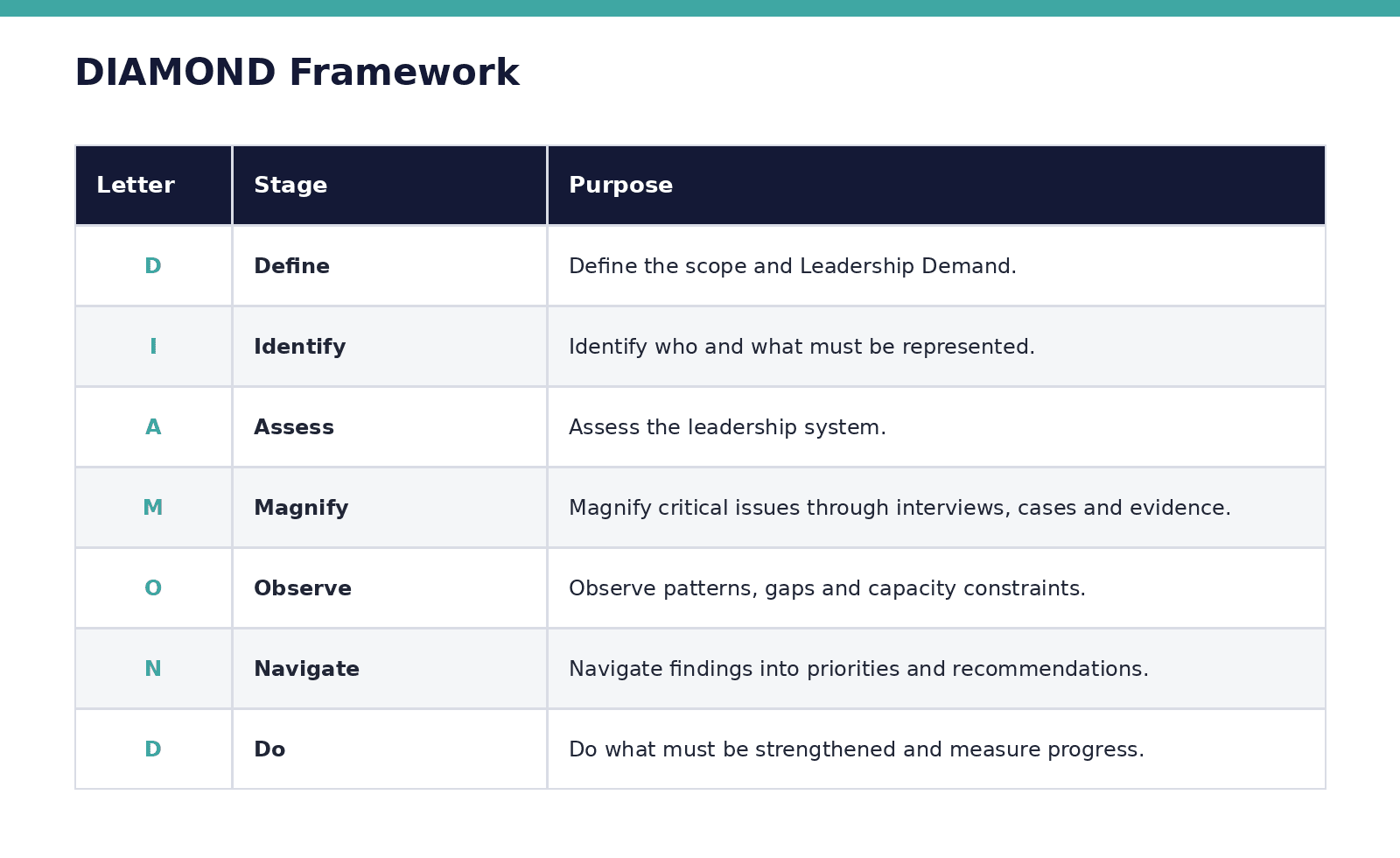
The objective is not measurement for the sake of measurement. It is to give decision-makers an evidence-based view of whether the leadership system has sufficient capacity to translate ambition into execution.
Leadership Capacity Is an Economic Issue
For governments responsible for substantial budgets, national programmes and major transformation investments, insufficient Leadership Capacity is not merely a leadership-development issue.
It can become an execution, productivity, investment and budget-efficiency issue.
When decisions are unnecessarily escalated, execution slows. When senior leaders become bottlenecks, organisational capacity is constrained. When strategic intent weakens across successive leadership levels, investment can be diluted before it reaches execution.
And when Leadership Capacity fails to keep pace with national ambition, the constraint can eventually become systemic.
Governments rightly ask whether they have sufficient financial resources, technology, talent and infrastructure to deliver their ambitions.
Perhaps another question now belongs alongside them:
Do we have sufficient Leadership Capacity for the ambition we are asking our institutions and leaders to deliver?
Because national ambition requires more than capable individuals. It requires a leadership system with sufficient capacity to turn ambition into sustained outcomes, without avoidable losses caused by insufficient Leadership Capacity.