

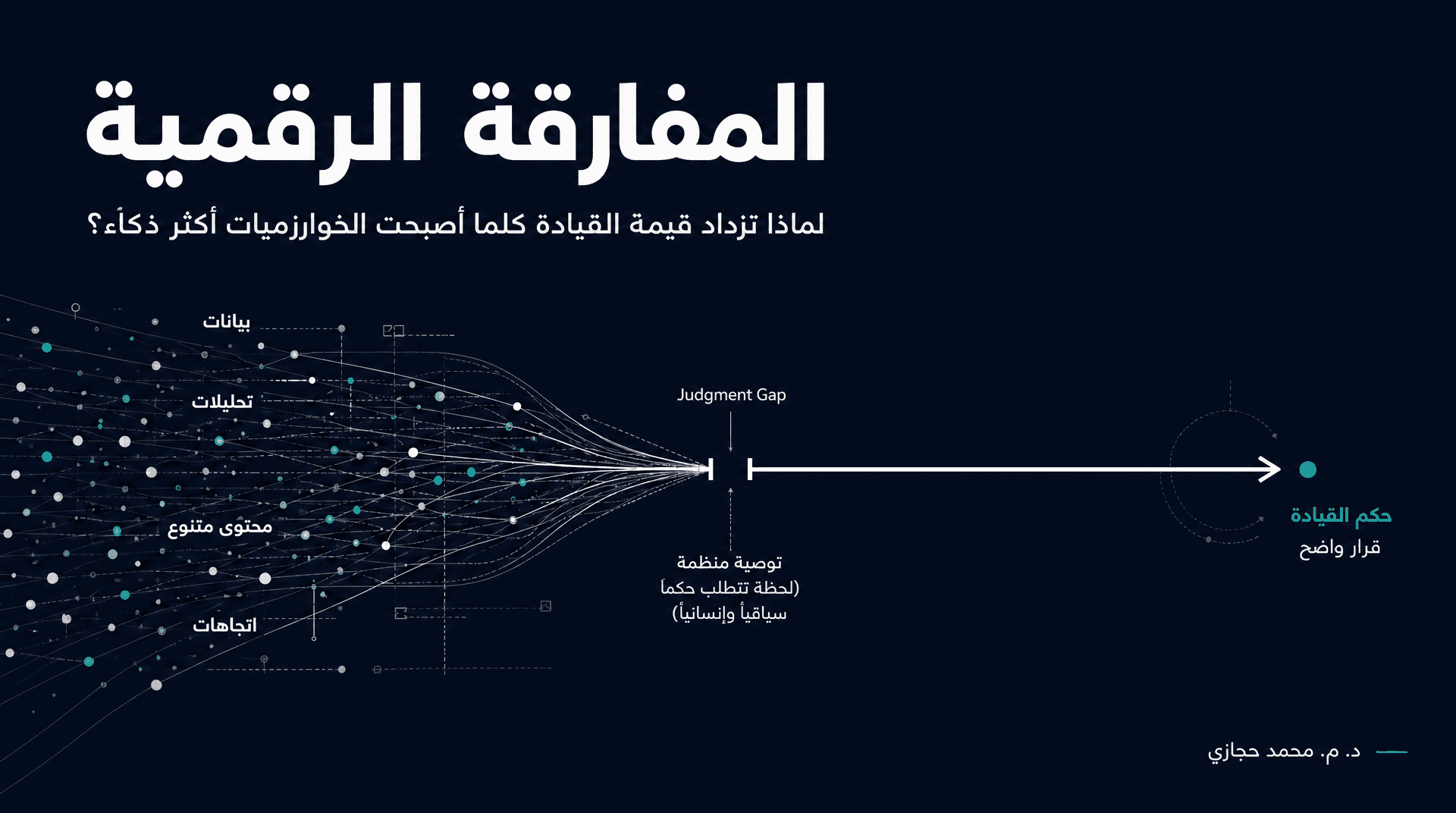
The question is no longer: How do we use AI? It is: How do we lead an organization when AI has become part of how it thinks?
Artificial intelligence has entered a new phase inside organizations.
It is no longer simply a tool that helps employees complete tasks faster or a system that analyzes data and presents results. Increasingly, AI is becoming part of how organizations interpret information, generate recommendations, compare alternatives, and make decisions.
This creates a paradox that deserves leadership attention:
The more capable algorithms become at producing answers, the more important human judgment becomes.
This is not a competition between humans and machines. It is a redefinition of leadership’s role when sophisticated analysis and recommendations become widely accessible.
When Answers Become Available to Everyone
For decades, many organizations built competitive advantage around a relatively simple equation:
Better Data → Better Analysis → Better Decisions → Greater Advantage
AI is changing an important part of that equation.
As advanced capabilities in analysis, prediction, and option generation become available to more organizations, the answer itself becomes less scarce.
When competitors can access increasingly similar analytical capabilities, possessing superior analysis alone is unlikely to provide sustainable differentiation.
Scarcity moves somewhere else:
The ability to judge the answer.
Did we define the right problem?
Are the assumptions behind the analysis still valid?
Does the recommendation make sense within the organization’s context?
Is what appears mathematically optimal actually what the organization should do?
And who is accountable for the outcome?
These are not primarily technical questions.
They are leadership questions.
The Digital Paradox
It would be easy to assume that advances in AI would gradually reduce the need for human judgment in decision-making.
The reality may be more complex.
As systems become increasingly capable of producing fast and accurate recommendations, larger questions emerge around context, purpose, and accountability:
- Who interprets the recommendation when the environment on which the model was built changes?
- Who balances competing objectives that cannot be reduced to a single metric?
- Who determines whether the question being answered is the question worth asking?
- Who owns the consequences when a recommendation is technically correct but strategically wrong?
This is the Digital Paradox:
The more efficient algorithmic recommendations become, the greater the need for mature human judgment.
Not necessarily because the machine has failed, but because its increasing capability raises the level of responsibility placed on those who use its outputs.
Decision Is One Thing. Judgment Is Another.
There is an important distinction between making a decision and exercising judgment.
A decision can be understood as choosing among alternatives according to a defined set of criteria and information.
Leadership judgment goes further.
It asks:
Does this decision serve the right purpose, in the right context, at a cost the organization is prepared to bear?
An algorithm may identify the most efficient alternative according to the criteria it has been given.
Leadership must consider what exists beyond those criteria.
The financially optimal decision in the short term may differ from the decision that best protects trust.
The most operationally efficient option may differ from the one that best supports long-term resilience.
And a recommendation may be perfectly consistent with historical data while being poorly suited to a future that is already beginning to look different.
Algorithms can optimize decisions.
Leadership gives them context, meaning, and accountability.
Leadership gives them context, meaning, and accountability.
When Machines Learn From a Past We Do Not Want to Repeat
One of the inherent characteristics of data-driven models is that they learn from what has already happened.
That is useful as long as the past remains a reasonable basis for understanding the future.
But what happens when historical data contains biases or patterns that the organization no longer wants to perpetuate?
A system trained on historical information can learn those patterns with remarkable efficiency and reproduce them through future recommendations.
The issue is not necessarily the model's ability to learn.
The deeper question comes before its use:
Is the past we learned from the future we actually want to build?
Data alone cannot answer that question.
When Reality Changes Faster Than the Model
There is another challenge with direct strategic implications.
Models learn from a world that can be observed and measured.
Organizations make decisions in a world that is constantly changing.
A model may be accurate. The data may be valid. The analysis may be logically sound.
Then the market, customer behavior, competitive landscape, or regulatory environment changes in a way that makes the assumptions underlying the decision less relevant.
Leadership responsibility appears again.
The question is not only:
Is the model accurate?
It is also:
Is the world on which the model was built still the world in which we operate?
The risk does not always come from a weak model.
Sometimes it comes from a good model operating on assumptions that have expired.
The Judgment Gap
This challenge can be summarized through what we might call the Judgment Gap.
It is the space between:
What the algorithm recommends
and
What the organization should decide.
This gap does not necessarily indicate a limitation of technology. It reflects a difference in the nature of the task.
Algorithms operate on data, patterns, probabilities, and defined objectives.
Leadership must also account for purpose, context, values, responsibility, and consequences.
The Judgment Gap commonly emerges from four sources:
1. Data Describes the Past
While decisions are made for a future that has not happened yet.
2. Not Every Form of Value Can Be Measured
Trust, reputation, legitimacy, and loyalty may be critical even when they cannot be reduced to a single metric.
3. Objectives Can Conflict
The best decision for short-term profitability may differ from the best decision for long-term trust or resilience.
4. Accountability Does Not Disappear
An algorithm may generate the recommendation, but responsibility for adopting and implementing it remains human and institutional.
The Leadership Judgment Hierarchy
The relationship between data, artificial intelligence, and leadership can be viewed as a hierarchy:
Wisdom
↑
Leadership Judgment
↑
Insight
↑
AI & Analytics
↑
Data
↑
Leadership Judgment
↑
Insight
↑
AI & Analytics
↑
Data
Each level depends on what comes before it, but cannot be reduced to it.
Data enables analysis.
Analysis supports insight.
But moving from insight to judgment requires understanding context, purpose, and consequences.
Wisdom emerges when leadership can use all of these elements to make a decision that is not merely analytically sound, but appropriate for the organization and its future.
AI, therefore, is not the top of the hierarchy.
It is one of its most powerful foundations.
From Governing Algorithms to Governing Decisions
AI governance has rightly focused on issues such as transparency, explainability, accountability, risk management, and human oversight.
But as AI becomes more embedded in organizational decision-making, another question emerges:
Is governing the technology enough, or must organizations also govern how its recommendations become decisions?
As systems gain greater autonomy, organizations need greater clarity around:
- Who owns the final decision?
- When is human review mandatory?
- Who has the authority to override an AI recommendation?
- Which assumptions must be periodically reassessed?
- How should exceptions be documented?
- Who remains accountable for the outcome?
This makes Decision Rights an integral part of AI governance rather than a separate management issue.
The risk is not only that an algorithm may produce the wrong recommendation.
The risk is also that its recommendation becomes convincing enough that the organization stops questioning it.
A Rule for Organizations in the Age of AI
The Digital Paradox can be expressed through a simple principle:
As the level of AI autonomy within an organization increases, so does the need for more mature leadership judgment, stronger governance, and clearer accountability.
A mature organization does not choose between humans and machines.
Instead, it defines clearly:
What should the machine do?
What must remain subject to human judgment?
And how should the two work together without allowing accountability to disappear between them?
What must remain subject to human judgment?
And how should the two work together without allowing accountability to disappear between them?
Five Questions That Should Reach the Boardroom
As AI moves from an operational tool to an increasingly influential component of organizational decision-making, boards should look beyond questions about technology adoption or expected returns.
More fundamental questions need to be asked:
-
Is the algorithm addressing the right problem in the first place?
-
What assumptions underpin its recommendation, and when might those assumptions become invalid?
-
What cannot be measured by the available data but still matters to this decision?
-
Who is accountable if the recommendation is technically correct but strategically wrong?
-
Who has the authority to override the algorithm, and how is that decision documented?
These questions do not diminish the value of artificial intelligence.
They make organizations more capable of using it responsibly and effectively.
The Next Competition Is Not Only Between Algorithms
Organizations have competed at different times over access to information, analytical capabilities, and now the adoption of artificial intelligence.
But as powerful technologies become broadly accessible, owning the technology itself will not be enough to create lasting advantage.
Differentiation will emerge elsewhere:
In the quality of the questions.
In clarity of purpose.
In the ability to challenge assumptions.
In the design of governance.
And in the maturity of leadership judgment.
Algorithms can tell us what is likely to happen.
Leadership remains responsible for deciding what should happen.
That is the Digital Paradox:
The more capable machines become at providing answers, the more valuable leadership becomes at judging those answers.